Reading Rämistrasse
#130: Georgia Hall on Monster Chetwynd at Cabaret Voltaire
#139: Georgia Hall & Ana Victoria Bruno on Fatima Moallim at Last Tango
#130: Georgia Hall on Monster Chetwynd at Cabaret Voltaire
There’s something about Monster
Anything interesting in there? a stranger asks me in English as soon as I arrive. Within minutes, we are deep in conversation and it’s nice. I am not looking to leave the conversation. It’s not awkward. It’s the first time, in years, that someone – a stranger – has spoken to me in Zurich. He knows the Director and has been to Cabaret Voltaire many times before. I have visited a few times myself and am ashamedly surprised by the new head-less-ness additions by Monster Chetwynd in the Artists’ Bar.
From the outdoor façade to below the bar, all free space is now adorned by ceramic masks and paper-mâché butterflies and has a centrepiece of loosely painted smiling faces overlooking the seating.
My colleague arrives and we get the drink never drinking alone. In the next room, tables are laid with different shapes and colours of raw pasta, glue guns, scissors, string and wire. Once we are sitting at a table a Swiss artist with floppy-blonde hair, and a future collaborator of Monster’s, joins us. He tells us about the many countries he has lived in over the last fifteen years and his return to Switzerland. Sipping beer, I played with the pasta for over an hour. I want to build an outfit. Gluegun every piece of pasta to my clothes and wear the coat home. We tell him about the experiences of being expats and the pains and joys of living in a new city.
Later two women join us who have collected pasta they like en-route to the table. They are too gorgeous to be so kind. They smile whilst transforming matching pasta headbands into million-dollar accessories. Talking to us, they regularly use the word beautiful.
I eventually decide on the direction of my necklace – a face with wild hair – and am ready to offer it to the guru and her disciple. I am meticulously guided to them by a chiselled young man wearing a silver leotard and a painted beard. They watch me kneel from their extravagant wooden chair as I desperately hold out my necklace.
You are accepted.
You may enter the performance.
Now standing on the staircase to hell, my colleague has left and a gentleman stands behind me chuckling at the queue. It’s all part of the experience. Monster appears. Talking to us all, have you seen this kid? she says as she points at a young boy confidently moving through the crowds to find his brother. Just a string and one small pasta piece, shaking her head with approval, too cool.
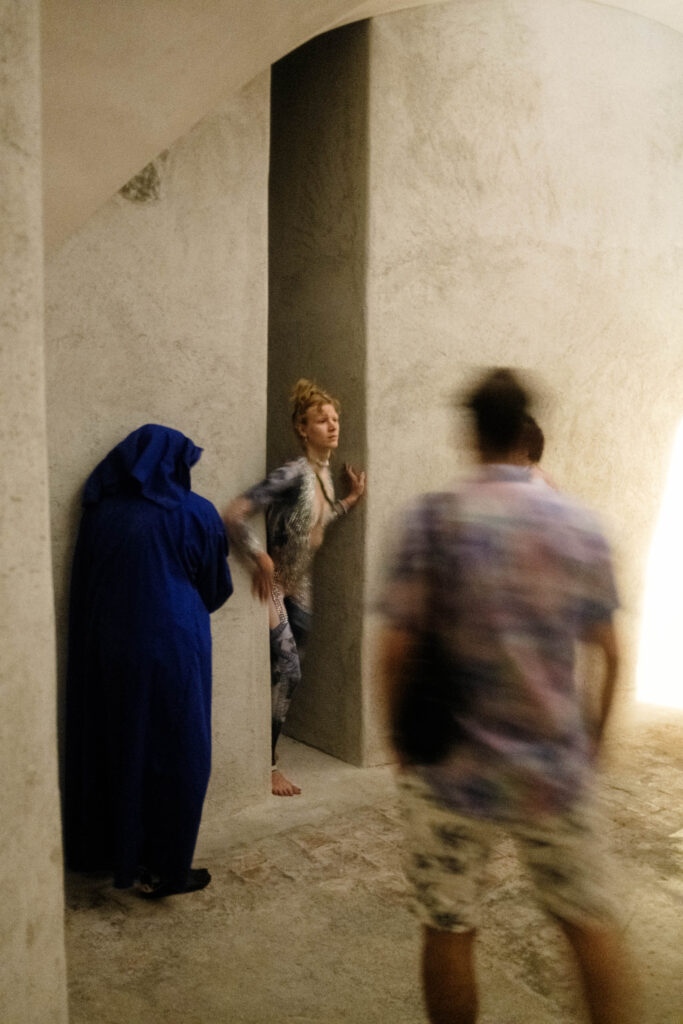
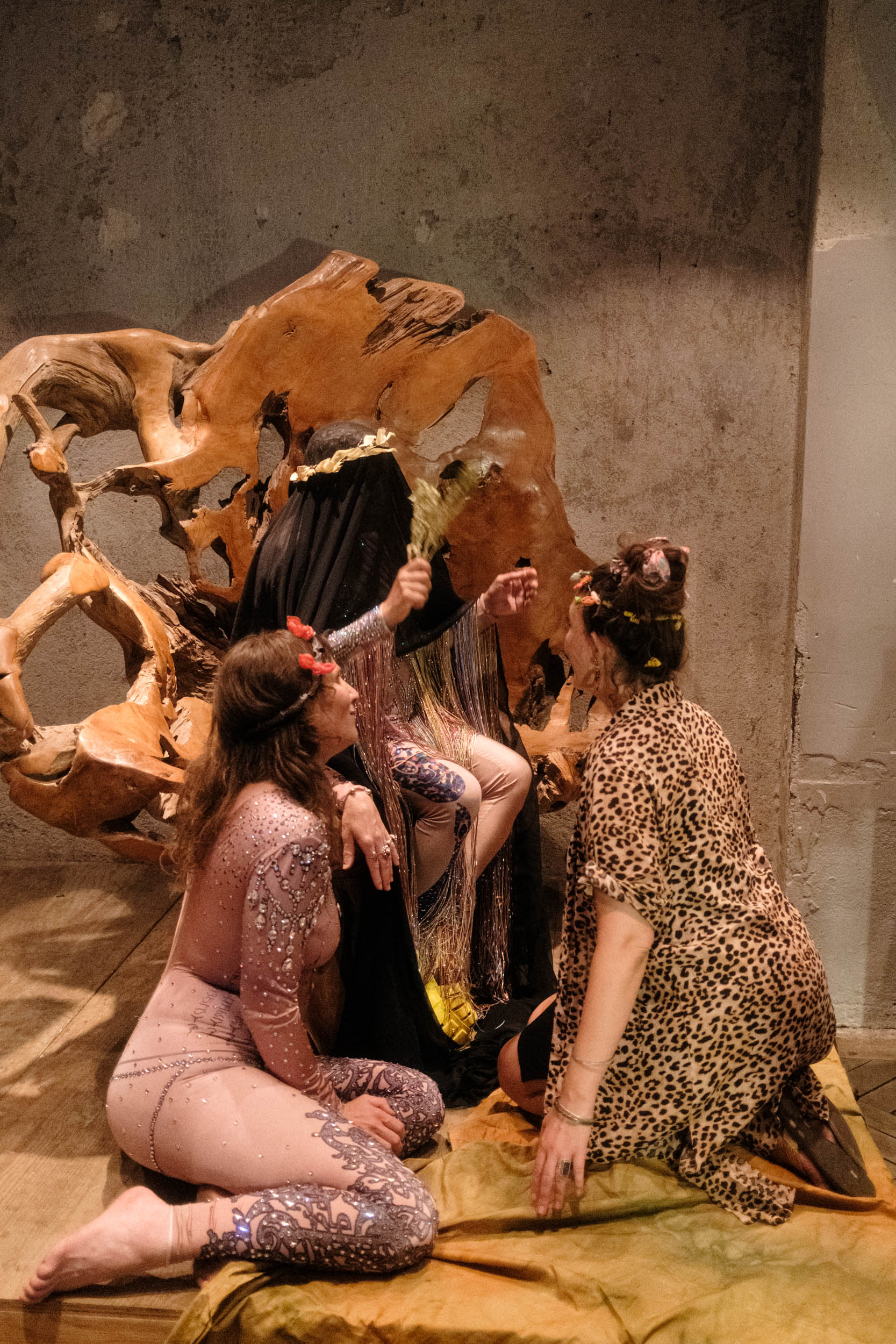
Whether she does or not, Monster seems to know everyone in the queue. People are selected to visit the cellar in small groups and are intimately guided around the space, witnessing sexual nymphs in their vault. Our guide, in a black and silver glitter leotard, is one of Monster’s oldest friends. With my peers, she keeps us close, encourages us to hold hands and whispers Beautiful when pointing out the performers and the artwork.
Set in the home of Dada, one could view this opening as an attempt to merge the supposedly frisky feminist Mina Loy with the choreography of Sophie Taeuber-Arp. The performers’ costumes, unlike those of Taeuber and the infamous Hugo Ball, suggest sexual freedom and acceptance.
The silence, concrete walls and dark lighting resemble a cave. Keep together. Closer, closer. Our disciple scoops us up in her arms and reveals a shy nymph in an alcove, twisting and turning, showing a glimpse of her curves through a see-through bodice. Beautiful. Quickly spun around, we witness a large tattooed satyr in a blue hooded kimono peering from the mouth of hell. Inside there is a display of ceramic masks with orange tongues and sunken eyes. The frozen faces of our ancestors.
The cellar is now transformed as the creatures dance amongst their sculptural props. The experience becomes essential to the work. The people. The closeness. The comfort. The beauty. The strangeness.
As the nymphs dance, shake their asses, stroke their thighs and show their tongues, I watch their leotard tassels shimmer in the light. A temptress. Beautiful. Tempted, I unashamedly make eye contact with every performer, though am unable to break their act.
As we make our way back around to the entrance, the bodies now gather behind us and stare. An intrigued gaze. They crawl on the walls and peer at us from the alcoves of their cave. Am I being enticed into heaven or hell? A space where pleasure meets mischief. Where art meets religion, to which we are all party, each wearing our pasta beads. I cycle home in the mid-summer heat. The sky turns grey and starts to grumble. Almost immediately, three lightning strikes appear above me and with only five minutes to my home, the storm hits. I am soaked by the rain. My clothes are see-through and stuck to my skin. The storm surrounds me and I smile. Beautiful.
credits:
Monster Chetwynd, Head-Less-Ness, Artists’ Bar, 26 August 2023–20 July 2024 & Profusion Protrusion, Vaulted Cellar, 9 June–17 September 2023, Cabaret Voltaire
Bar opening: 25. August 2023 with Iron Age Pasta Necklace Workshop and performances, performers Monster Chetwynd, Dragan Chetwynd, Mariuccia Casadio, Lucy Soni, Jack Brennan, Ella Soni, Mette Sterre, Luca Süss, Dudu, Lukas Ryffel and Levin Stettler Brogli.
#139: Georgia Hall & Ana Victoria Bruno on Fatima Moallim at Last Tango
The Hearing Trumpet
The Zürich-based off-space Last Tango’s solo exhibition of seven drawings by self-taught artist Fatima Moallim (1992), curated by Fabian Flückiger, is an unexpected sonic journey, including works oscillating between powerful emotions and quiet reflective moments. Moallim’s practice, based on personal experiences, draws from the entirety of her persona. Each artwork captures an emotional state. The stronger the emotion, the more the lines thicken, taking up space on the paper’s surface. The calmer, the more lines dissipate and allow for narratives to emerge. These silent drawings, on which few lines travel across paper, whisper stories.
Moallim works quickly to capture the intensity of a moment. Her lines are rough, and the colouring, where present, imprecise. In BESVÄRLIGA LJUD, (all works 2023) the hectic process results in an overlap of black oil sticks and pencil lines, forming a dark vertigo. The texture of the drawing is akin to the dense noise of contemporary urban life. It violently resonates in the body. Moallim’s hand finds patterns and breaks them, again and again, translating a dystopic symphony onto paper.
AAA recreates similar experiences. Cutting through the drawing like a sharp scream, the letter A is repetitively written over a confused mash of green and black lines, arising from the guts, traversing the throat and shaped by the mouth, only to be eventually muttered, reabsorbed in the chaos, as the last few “A”s are cancelled out by energetic lines.
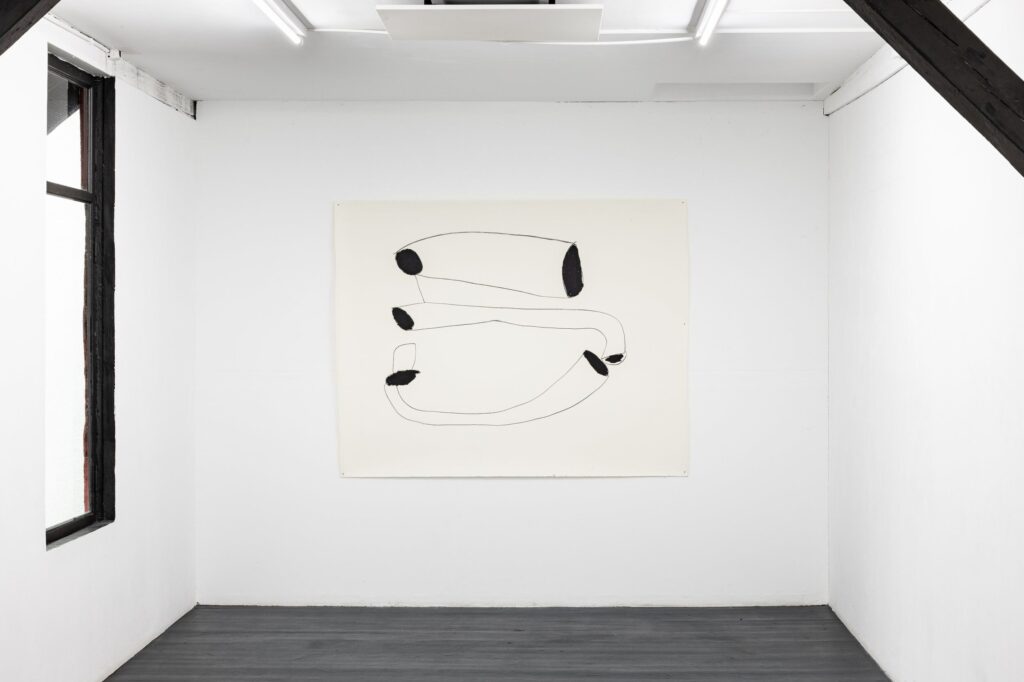
At the back of the space, SVART TIGER (black tiger) hangs against white walls with black-painted beams. A paper line drawing with four oblong shapes piled on top of each other. Stacked limbs, a finger, a forearm. Pipes, almost joining but not quite. Shown in Switzerland, historically home to many influential surrealist artists, one could also see hearing trumpets, archetypes of those one might need in older age, once hearing has gone and there is no option other than a large trumpet ‘grandly curved like a buffalo’s horn’. In Leonora Carrington’s 1974 novel, The Hearing Trumpet, protagonist Marian Leatherby, ‘hard of hearing’ but ‘full of life’, builds a utopia of werewolves, cats and mushrooms, where sound enables a world of surrealism with Carrington’s subconscious at the forefront.(3) In contrast to the 30+ billion-dollar noise-cancelling industry, ‘the hearing trumpet [magnifies] sound to such a degree that ordinary conversation [becomes] quite audible’.(2) Whilst Marian’s hearing enables inclusion in an inaccessible world, at the same time, as the drawings of Moallim signify, it also creates psychological wounds, such as the realisation that she, as a nonagenarian, is unwanted. Moallim’s work, embedded with migratory themes, can be found simmering under the surface, silent but visceral. Arguably, both Marian and Moallim are inside two worlds; one with the choice to enter the chaos and the other remaining silent.
Svart tigers are rare, with the few documented sightings similar to those of black panthers. From the title, this work nods to the neighbouring drawing MALCOLM’S BROTHER, which references the prominent black American activist and forefounder of the Black Panthers, Malcolm X. Placed together in a dialogue, these works reflect experiences of systematic racism, xenophobia, civil war and religious violence, all deeply rooted across the world today. A body in a box, another one lying down and a memorial seen from two different points of view are to be found in linked lines. With a few marks, the work resembles a sketch for a movie scene. They are quietly loaded works. Silence can also be a tool to shut down diverging voices, erasing stories and oral histories. Born in Russia to Somalian parents and based in Sweden, Moallim brings to the surface the colonial history of Western societies, and with a handful of lines, the work opens up fragmented conversations. Trauma needs healing, ignored conversations need to be heard and silenced narratives need to gain space in contemporary discussions. Silence and sound need to coexist, as the first gives space to the second.
credits
1+2 The Hearing Trumpet, Leonora Carrington, 1974
3 Afterword by Olga Tokarczuk to The Hearing Trumpet, Leonora Carrington, 1974
Fatima Moallim, curated by Fabian Flückiger, Last Tango, Zurich, 24 November 2023–27 January 2024